


HIV is a chronic viral infection whose prognosis has improved significantly with effective antiretroviral therapy (ART). For underwriters, the most important prognostic factors are CD4 count, viral load/virologic response, treatment adherence, AIDS-defining conditions, and HBV/HCV coinfection. Sustained viral suppression with good CD4 recovery is associated with substantially lower mortality, while virologic failure, low CD4 counts, AIDS, and ongoing high-risk behaviors indicate poorer prognosis. With appropriate treatment, monitoring, and favorable prognostic factors, carefully selected individuals with HIV may be considered for insurance with ratings.
Introduction
Human immunodeficiency virus (HIV) is a blood-borne, sexually transmissible viral disease. This virus is typically transmitted via sexual intercourse, shared intravenous drug paraphernalia, and perinatally during the birth process or via breast milk.
As per U.S. Centers for Disease Control and Prevention (CDC) there were 31,800 estimated new HIV infections in 2022; of those 67% were among those who reported men who have sex with men (MSM) contact, 22% were among those who reported heterosexual contact, and 7% were among those who injected drugs.
There are two distinct species of HIV viz., HIV-1 and HIV-2 and each of them is composed of multiple subtypes. Genetically, HIV-1 and HIV-2 are superficially similar, but each contains unique genes and its own distinct replication process. HIV-2 carries a slightly lower risk for transmission and tends to progress slowly to acquired immune deficiency syndrome (AIDS). Persons infected with HIV-2 tend to have a lower viral load than people with HIV-1, and a greater viral load is associated with more rapid progression to AIDS.
Risk factors for НIV transmission include high viral load (high levels of virus in blood), certain sexual behaviors, presence of ulcerative sexually transmitted infections, lack of circumcision, as well as certain other host and genetic factors.
Classification
HIV infection can be divided in three stages – acute infection, chronic infection without acquired immunodeficiency syndrome (AIDS), and advanced infection with AIDS. CDC and World Health Organization (WHO) classify HIV infection as advanced/severe when the CD4 count is <200 (expressed in cells/microL) in individuals of age >5 years. Individuals who present with AIDS-defining condition (a list of AID-defining conditions is appended below) along with advanced or severe infection are termed to have AIDS.
Treatment
Treatment of HIV disease depends on the stage of the disease and any concomitant opportunistic infections. Antiretroviral therapy (ART), highly active antiretroviral therapy (HAART), or combination antiretroviral therapy (cART) are the principal methods for preventing immune deterioration. Rapid treatment initiation for ART, HAART, or cART as soon as possible in patients with newly diagnosed HIV infection is highly recommended and has been reported by several studies to offer excellent outcomes. The choice of ART or HAART as the treatment regimen is dependent on viral load, CD4 count, and clinical findings. Successful treatment for HIV is demonstrated by gradual recovery of CD4 T-cell numbers, undetectable viral load, and an improvement of immune responses.
Prognosis
Prognosis in HIV is primarily determined by several factors including, avoidance of risky behavior that may expose the individual to the virus or transmit the virus, CD4 count, and virologic response.
Follow-ups after initiation of treatment ranges from four weeks to six months depending on the response achieved with treatment. The first follow-up is within four weeks and subsequent follow-ups are conducted at every three to six months depending upon the tolerance to treatment regimen and the virologic response achieved. Once stabilized on treatment and the individuals have achieved a sustained virologic response, follow-up at every six months is recommended. These follow-up timelines are important for underwriters in documenting and recording the CD4 count and viral load as they are the most reliable factors that guide prognosis in HIV individuals. The importance of this can be understood by developing a deeper understanding of the virologic response and CD4 counts.
Virologic Response
Plasma HIV RNA level often referred as viral load (expressed as copies/mL) is regularly measured in all individuals treated for HIV. It is one of the most reliable indicators of response to treatment. The goal of treatment is to achieve virologic suppression and to ultimately have an undetectable viral load. Underwriters often come across several terms for virologic response, a few of these that are pertinent to underwriters are included here.
Undetectable viral load – no virus is detected in blood.
Virologic suppression – refers to both ‘undetectable viral load’ as well as ‘viral load that is detected but is only between 20-40.’
Viral blips – refers to an isolated low-level of detectable viral load generally between 20-200 copies/mL, that occurs during long-term monitoring of individuals who are virologically suppressed or have undetectable viral load. Viral blips are not uncommon and may not reflect virologic failure. However, underwriters should be cautious when they observe these viral blips and should underwrite these individuals with caution based on the frequency of viral blips and the viral load. Viral blips could be indicative of suboptimal or intermittent adherence to treatment and/or drug interactions.
Virologic failure – refers to individuals who do not achieve viral load of <200 within 24 weeks of initiating treatment or if they have sustained recurrence of viral load of >200 on two consecutive measurements after initial viral suppression. The two main causes of virologic failure are medication resistance and/or subtherapeutic drug levels mostly occurring due to poor adherence to treatment regimen.
CD4 count
As virologic response relates to response to treatment, CD4 count relates with immune response.
If CD4 count at initiation of treatment is >500 and viral load is undetectable CD4 count monitoring is not needed. However, if the individual has virologic suppression then CD4 count is monitored every 2 years.
If CD4 count at initiation of treatment is 300-500, CD4 count is monitored every 6 months until virologic suppression is achieved for 1 year. After that, CD4 count is monitored annually until it reaches >500. Once CD4 count is >500, then monitoring is optional.
If CD4 count at initiation of treatment is <300, CD4 count is monitored every 3 months after initiation treatment. If the CD4 count improves to >300 then it is monitored every 3 to 6 months until sustained virologic suppression is achieved for 1 year and CD4 count is >500; after that CD4 count monitoring is optional.
In instances of virologic failure, CD4 count monitoring is done every 3 months irrespective of CD4 count at baseline until undetectable viral load is achieved and CD4 count of >500.
It is extremely important for underwriters to record virologic response and CD4 counts in all individuals with HIV to observe treatment progression and to identify viral blips or virologic failure.
Mortality
Mortality in individuals with HIV is dependent on several factors, of which the most important ones are:
With AIDS – HIV individuals with an AIDS-defining condition have a very high mortality risk, >3.5-fold in comparison to HIV individuals who do not have AIDS. They remain beyond insurable limits.
Mode of HIV transmission – Individuals indulging or continuing to be an environment of high-risk behaviors such as unprotected sex, multiple partners, intravenous drug use are at an extremely high risk of mortality. Studies have identified very high mortality rates in these individuals, most often beyond insurable limits.
Coinfection with HCV or HBV – Coinfection with hepatitis C virus or hepatitis B virus increases the risk manifold for mortality from liver disease and liver-failure.
Viral load – Individuals with sustained virologic response demonstrated by undetectable viral load for a significant period has significantly lower mortality in comparison to those with virologic failure.
CD4 count – CD4 count has been identified as an important and independent marker of mortality. CD4 count consistently of >350 is associated with much lower mortality compared to those with CD4 count of <200.
Age – Young age individuals are at high risk of mortality compared to elderly individuals. A study published in Lancet (2017) noted that HIV individuals of age 30-39 years have a 1.5-fold elevated risk mortality compared to HIV individuals of age >60 years.
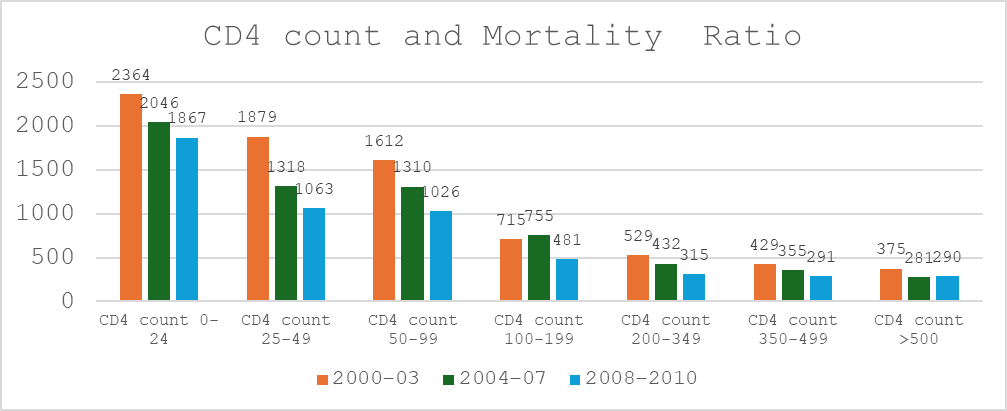
The above chart shows mortality ratios associated with CD4 count that has changed over the last few years. Source – Lancet Study, 2017.
Underwriting Implications
Over the last decade, with the availability of ART, HAART, and cART; improvements in compliance and adherence to treatment regimen including regular follow-ups; and reduction in toxicities caused by HIV medications has contributed significantly to lowering mortality in HIV individuals. HIV individuals if selected appropriately by underwriters based on prognostic factors can be offered insurance with some ratings.
Meet the Authors & Experts
Dr. Rahul Nawander MD, FALU, FLMI
Insurance Medicine · Life Expectancy Assessment · Underwriting Guidelines · Underwriting Technology · Complex Claims
